
How to Choose a Stinging Nettle Root Supplement
By Real Herbs Editorial Team · Published October 2026 · Updated October 2026 · 8 min read
Key takeaway: A supplement label cannot tell you whether a product works, but it can tell you whether you are comparing like with like. Check the plant part (root, not leaf), the species, the extract ratio and amount per serving, the other ingredients, whether a recognized third-party seal is verifiable, and who stands behind the product. Supplements are not approved by regulators before sale, so these checks and a conversation with your doctor or pharmacist do most of the work.
Nettle root capsules, tinctures, teas and powders differ in plant part, strength and quality, and the labels are not always easy to compare. This guide is a practical checklist for reading a nettle root supplement label, with the evidence behind each check and the limits of what any label can tell you.
Disclosure: Real Herbs sells a stinging nettle root extract, so we have a commercial interest in this topic. The checklist applies to our product and to everyone else’s, and you can ask any maker, including us, the questions below.
How supplements are regulated
In the United States, the National Institutes of Health (NIH) Office of Dietary Supplements explains that supplements are not medicines and are not meant to treat, diagnose or cure disease. Medicines must be approved by the FDA before sale, and supplements do not require that approval. Companies must have evidence that their products are safe and that label claims are truthful, but they generally do not have to submit it to the FDA first. They must follow Good Manufacturing Practices (GMPs), the FDA can remove unsafe products, and health claims on labels must carry a disclaimer that the FDA has not evaluated them ([1]). The FDA itself states that under the Dietary Supplement Health and Education Act it cannot approve supplements for safety and effectiveness before they are marketed ([2]).
The practical consequence is that the burden of comparing products falls partly on the buyer. The rest of this guide helps with that.
The label checklist
Swipe sideways to see all columns.
| Check | What to look for | Why it matters |
|---|---|---|
| Plant part | “Root” or “radix” on the label, not just “nettle” or “Urtica dioica” | The prostate research used root extracts, while most other nettle trials used leaf or mixed products. See our root versus leaf guide ([3]) |
| Species | Urtica dioica (or Urtica urens) | These are the species the EMA names for the root herbal substance ([3]) |
| Extract ratio and amount | The ratio (for example 10:1) and the milligrams per serving | A 10:1 extract means roughly 10 parts of dried plant went into 1 part of extract, so a figure for extract and a figure for dried herb are not the same thing. Our dosage, timing and forms guide explains this |
| Extraction method | The solvent used, if stated (water, ethanol, methanol) | Trials used particular extracts, for example a proprietary methanolic extract ([4], PMID 17509841). A product that does not say how it was made cannot be matched to a trial extract |
| Serving size and directions | Servings per container and the directions on the label | The maker suggests the serving size, and your provider may recommend a different one ([1]) |
| Other ingredients | Fillers, binders, capsule material (vegetarian or gelatin) and allergens | Listed separately from the active ingredient on the Supplement Facts label ([1]) |
| Third-party seals | A seal from an independent group such as NSF International or U.S. Pharmacopeia (USP), with a number you can check on their site | Independent testing exists, but seals do not guarantee that a product is safe or effective ([1]) |
| Who stands behind it | Manufacturer name, address, contact details and a clear return policy | Lets you report a problem or ask for documents. People should tell their provider and report bad reactions to the FDA and the maker ([1]) |
Questions you can put to any seller: Which part of the plant is used? What is the extract ratio and the solvent? Can I see a certificate of analysis for this batch, from which laboratory? Is the facility inspected, and by whom? A seller who answers clearly is easier to trust than one who relies on marketing language.
Quality and authenticity
Herbal products can be mislabeled or contaminated. We did not find a study of the authenticity of nettle root products, so we cannot say how common the problem is for nettle. Studies of other herbs show why it is worth asking:
- A UK study used DNA barcoding on 25 Siberian ginseng and 14 roseroot products. All ginseng products contained the labeled species, but 36% also contained another Eleutherococcus species. Of 13 roseroot products that gave readable DNA, only five matched the target species, and the authors concluded that substitution or mixing is common in these two supplements ([5], PMID 29154110).
- An FDA laboratory study of 112 market samples of ginkgo, soy, valerian, yohimbe and St. John’s wort compared chemical marker tests with DNA barcoding. The authors describe the limits of each approach: chemical marker tests struggle when the marker compounds are not unique to a species, and DNA barcoding raises concerns when used on processed finished products ([6], PMID 28454189).
- A review of DNA-based authentication described cases where supplements contained materials other than the stated ingredient and concluded that there is a need for greater quality control in the industry ([7], PMID 25856442).
- A 2026 laboratory analysis of nine anti-hair-loss supplements made from bamboo, horsetail or nettle found cadmium above the EU limit in one horsetail product and a silicon content in another horsetail product about eight times lower than declared. The authors developed a validated laboratory method to measure these elements ([8], PMID 42883682).
None of these studies tested a nettle root capsule, and they should not be read as a finding about nettle products. They show that label claims and contents can differ, and that an independent test of a specific batch is the most direct answer. The EMA report also notes that pharmacokinetic data for nettle root are absent ([3]), so claims that one nettle root product is absorbed better than another are untested.
Claims, blends and combinations
Disease claims. Because supplements are not meant to treat or cure disease ([1]), be cautious with any nettle root label or advert that promises to treat a condition. The nettle root research is mostly about urinary symptoms of BPH, and our BPH guide sets out what it found.
Blends. Nettle root is often sold in blends. The best-studied blend is a fixed combination of saw palmetto and nettle root extracts, tested in a handful of trials, which do not tell us what either herb does alone; see our nettle root versus saw palmetto guide. Other herb pairings have not been tested in trials we cite, so a claim of “synergy” is a hypothesis.
Sourcing and strength. A bigger number on the front of the bottle is not better evidence. A figure for dried herb equivalent, such as 7,500 mg for a 750 mg 10:1 extract, is a calculation from the ratio, not a measure of an active ingredient. Compare extract ratio, solvent and amount per serving across products, and keep in mind that trials tested specific extracts.
Before you buy: talk to your doctor
The NIH advises telling all your providers about every supplement you take, keeping a record of names, doses and reasons, and telling your provider before surgery, since some supplements can affect bleeding or anesthesia ([1]). The FDA also advises talking to a doctor, pharmacist or other health professional before buying or using a supplement ([2]). For nettle root, our guides to side effects and who should avoid it and to medicine interactions cover what to check. If you are considering nettle root for urinary symptoms, see a doctor first, since several serious conditions cause the same symptoms.
Frequently asked questions
How do I know a nettle root supplement is real?
No label alone proves that. Check that it names the root, the species, the extract ratio and the amount, look for a verifiable third-party seal, and ask the seller for a batch certificate of analysis. Studies of other herbs found label mismatches in some products, so independent testing of a batch is the most direct check.
What does 10:1 mean on a nettle root label?
It means roughly 10 parts of dried plant were used to make 1 part of extract. A 750 mg capsule of 10:1 extract corresponds to about 7,500 mg of dried root.
Is nettle root extract better than nettle root powder?
The trials we cite used extracts, and we found no study comparing extract with powder. They are different materials with different strengths, so numbers on their labels cannot be compared directly.
Are third-party seals a guarantee?
No. Independent organizations such as NSF International and USP offer testing and seals, but seals do not guarantee that a product is safe or effective.
Does nettle root come from the leaf or the root?
It depends on the product. Check for the word root or radix. Leaf and root are different materials with different uses and research.
Can I take nettle root with other supplements?
Interaction data are limited. Ask your doctor or pharmacist, especially if you take prescribed medicines or are preparing for surgery.
What should I do if I have a bad reaction?
Stop using the product, tell your health provider, and report the reaction to the FDA and the manufacturer, as the NIH advises.
Does Real Herbs nettle root contain 750 mg?
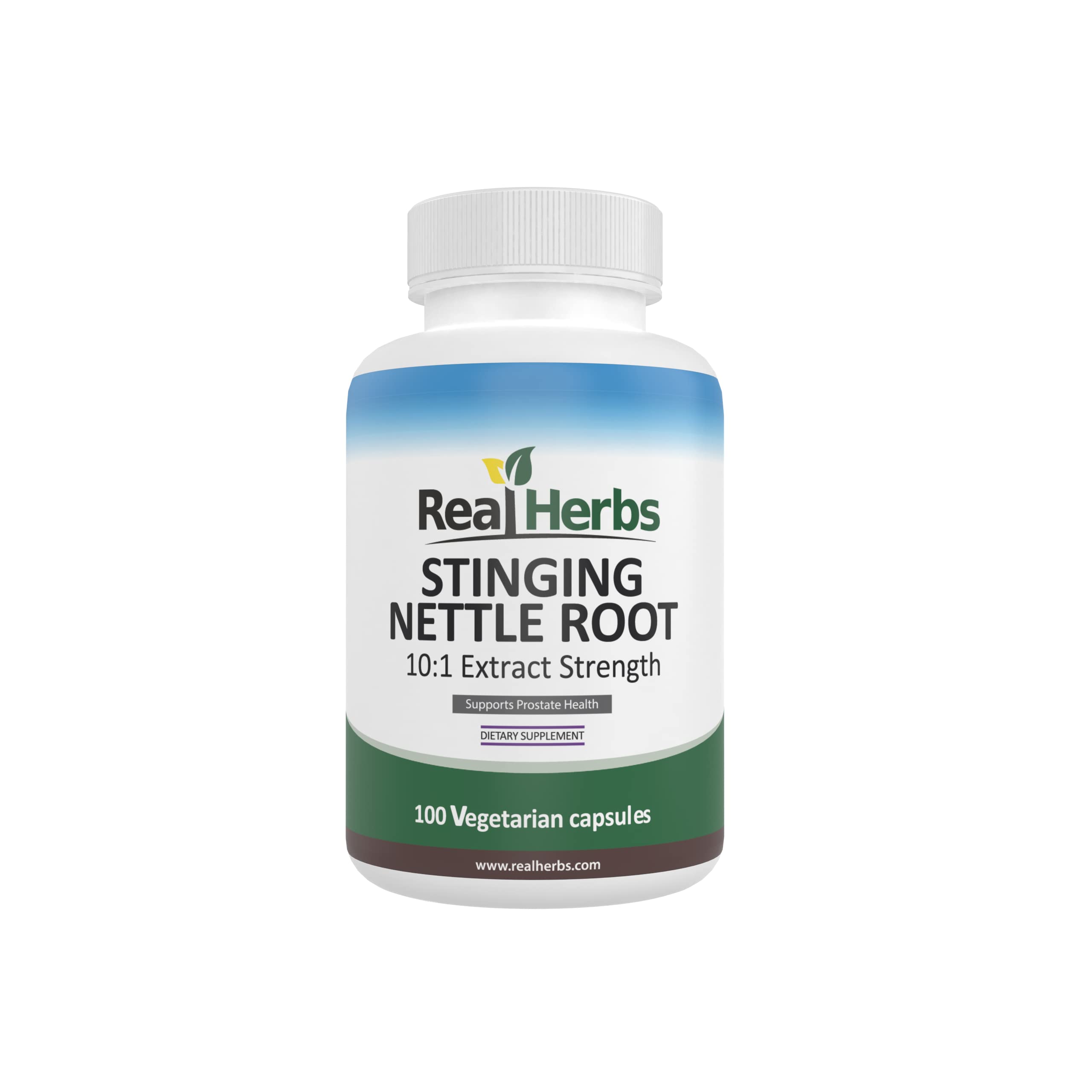
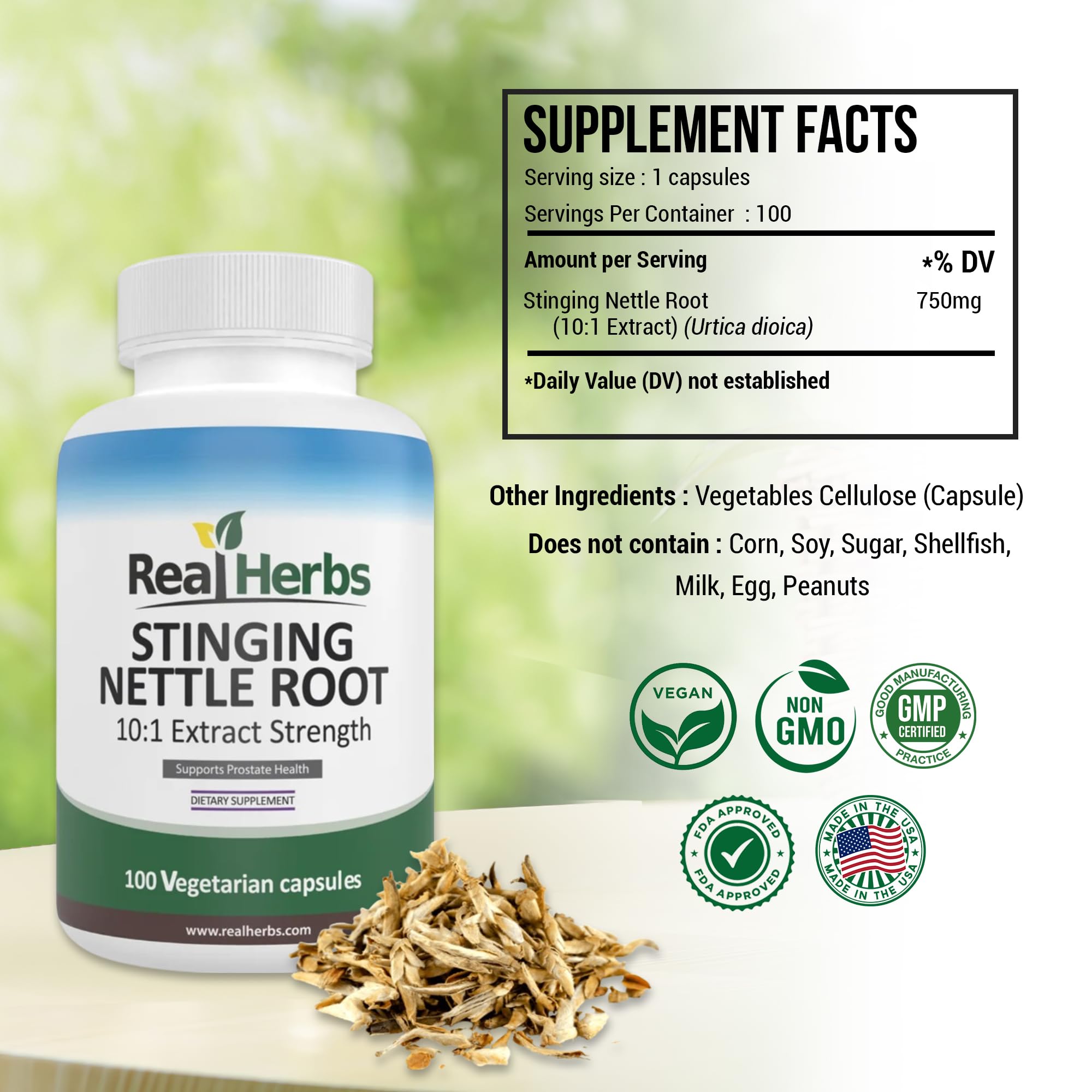
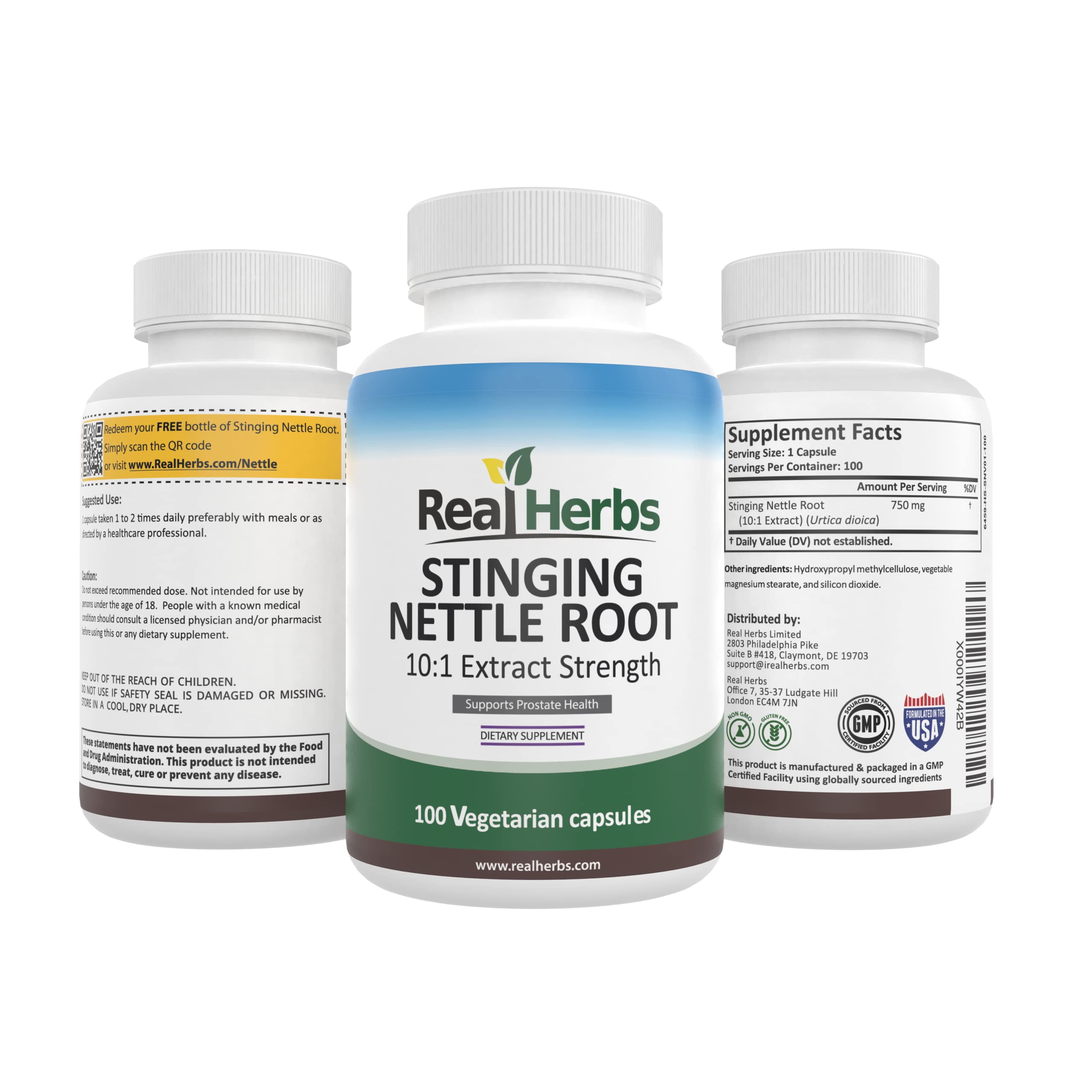
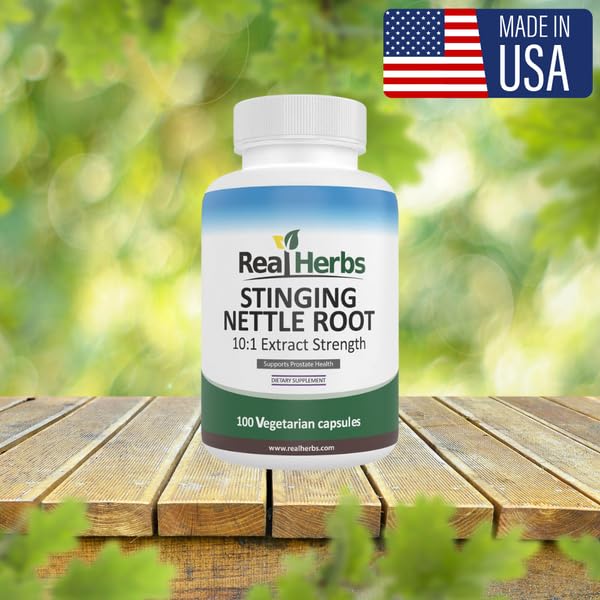
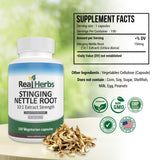
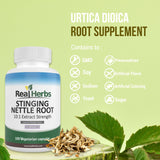
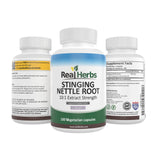
The product is labeled as 750 mg of 10:1 root extract per capsule (about 7,500 mg dried root equivalent), 100 vegetarian capsules.
The bottom line
A good nettle root label names the root and species, states the extract ratio and the amount per serving, lists other ingredients plainly and gives you a way to contact the maker. Seals and batch documents add confidence but not certainty, and none of this replaces advice from your doctor or pharmacist.
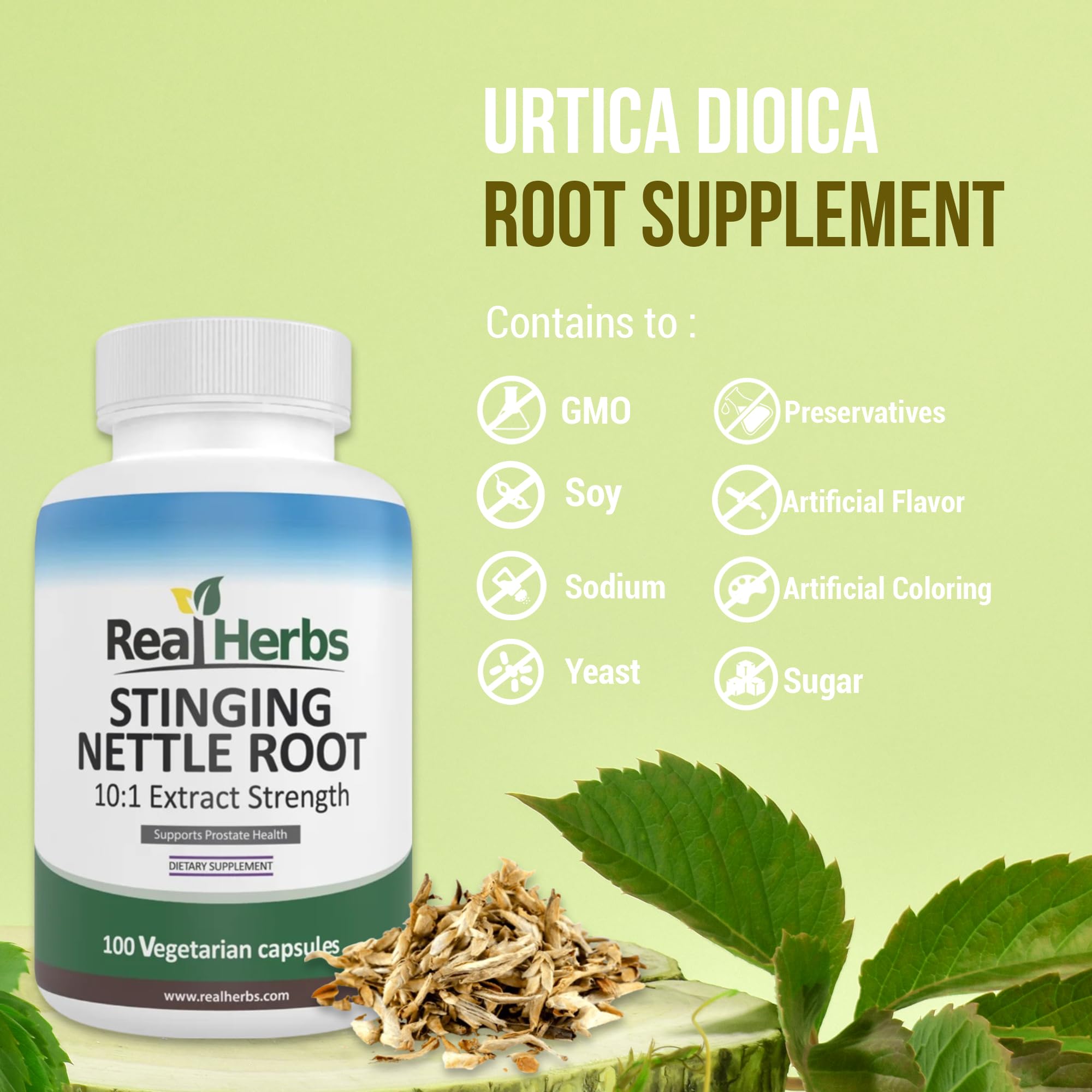
Real Herbs Stinging Nettle Root Extract: 750 mg of 10:1 root extract per capsule (about 7,500 mg dried root equivalent), 100 vegetarian capsules. Backed by our 100-Day Money-Back Guarantee. Real Herbs sells this product. The trials and the EMA documents did not test this exact product.
Related reading
- What is stinging nettle root?
- Stinging nettle root dosage, timing and forms
- Nettle root vs. nettle leaf: key differences
- Nettle root side effects and who should avoid it
References
- National Institutes of Health, Office of Dietary Supplements. Dietary Supplements: What You Need To Know. Page updated 4 January 2023. ods.od.nih.gov
- U.S. Food and Drug Administration. Information for consumers on using dietary supplements. Accessed October 2026. fda.gov
- European Medicines Agency, Committee on Herbal Medicinal Products. Assessment report on Urtica dioica L.; Urtica urens L., radix. EMA/HMPC/322627/2023. Final, Revision 1, 22 January 2025. ema.europa.eu
- Chrubasik JE, Roufogalis BD, Wagner H, Chrubasik S. A comprehensive review on the stinging nettle effect and efficacy profiles. Part II: urticae radix. Phytomedicine. 2007;14(7-8):568-79. PMID 17509841 · DOI 10.1016/j.phymed.2007.03.014
- Ruhsam M, Hollingsworth PM. Authentication of Eleutherococcus and Rhodiola herbal supplement products in the United Kingdom. J Pharm Biomed Anal. 2018;149:403-409. PMID 29154110 · DOI 10.1016/j.jpba.2017.11.025
- Pawar RS, Handy SM, Cheng R, Shyong N, Grundel E. Assessment of the authenticity of herbal dietary supplements: comparison of chemical and DNA barcoding methods. Planta Med. 2017;83(11):921-936. PMID 28454189 · DOI 10.1055/s-0043-107881
- Coutinho Moraes DF, Still DW, Lum MR, Hirsch AM. DNA-based authentication of botanicals and plant-derived dietary supplements: where have we been and where are we going? Planta Med. 2015;81(9):687-95. PMID 25856442 · DOI 10.1055/s-0035-1545843
- Krawczyk-Coda M. Determination of cadmium, copper, lead, and silicon in anti-hair loss dietary supplements that contain various plant-derived silicon sources. Foods. 2026;15(19):3577. PMID 42883682 · DOI 10.3390/foods15193577
Disclaimer: This article is for educational purposes only and is not medical advice. Talk with a qualified healthcare professional before starting any supplement, especially if you have a medical condition or take medication. These statements have not been evaluated by the Food and Drug Administration. This product is not intended to diagnose, treat, cure, or prevent any disease.