
Stinging Nettle Root Dosage, Timing and Forms: What the Research Shows
By Real Herbs Editorial Team · Published October 2026 · Updated October 2026 · 10 min read
Key takeaway: No single dose of stinging nettle root is established. The nettle root trials report 450 mg a day of root extract and a 459 mg dry extract, and a European Medicines Agency (EMA) monograph lists several regimens that depend on the type of extract. Because extracts differ in ratio and solvent, the most useful number is the one on your product's label, and a doctor or pharmacist can help you fit it to your situation. The trials judged results after 12 weeks to 12 months. None of the studies cited here tested time of day, tea or tincture.
Stinging nettle root (Urtica dioica) is sold as capsules and tablets, liquid extracts and cut root for tea. This guide brings together what human trials and the EMA monograph say about how much to take, which form to choose, whether timing matters and how long to take it.
Disclosure: Real Herbs sells a stinging nettle root extract. We report each dose as it was published.
How to read a nettle root label
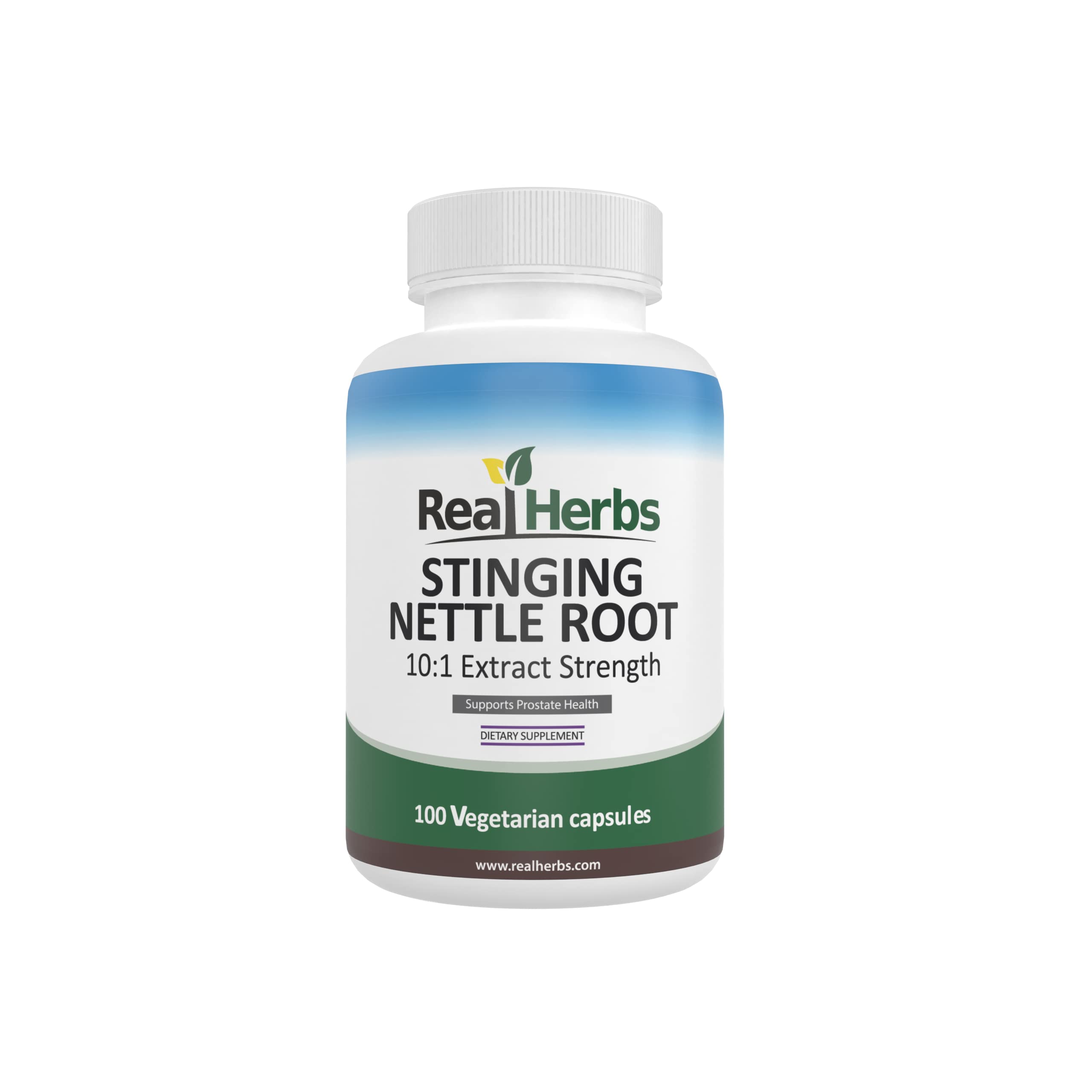
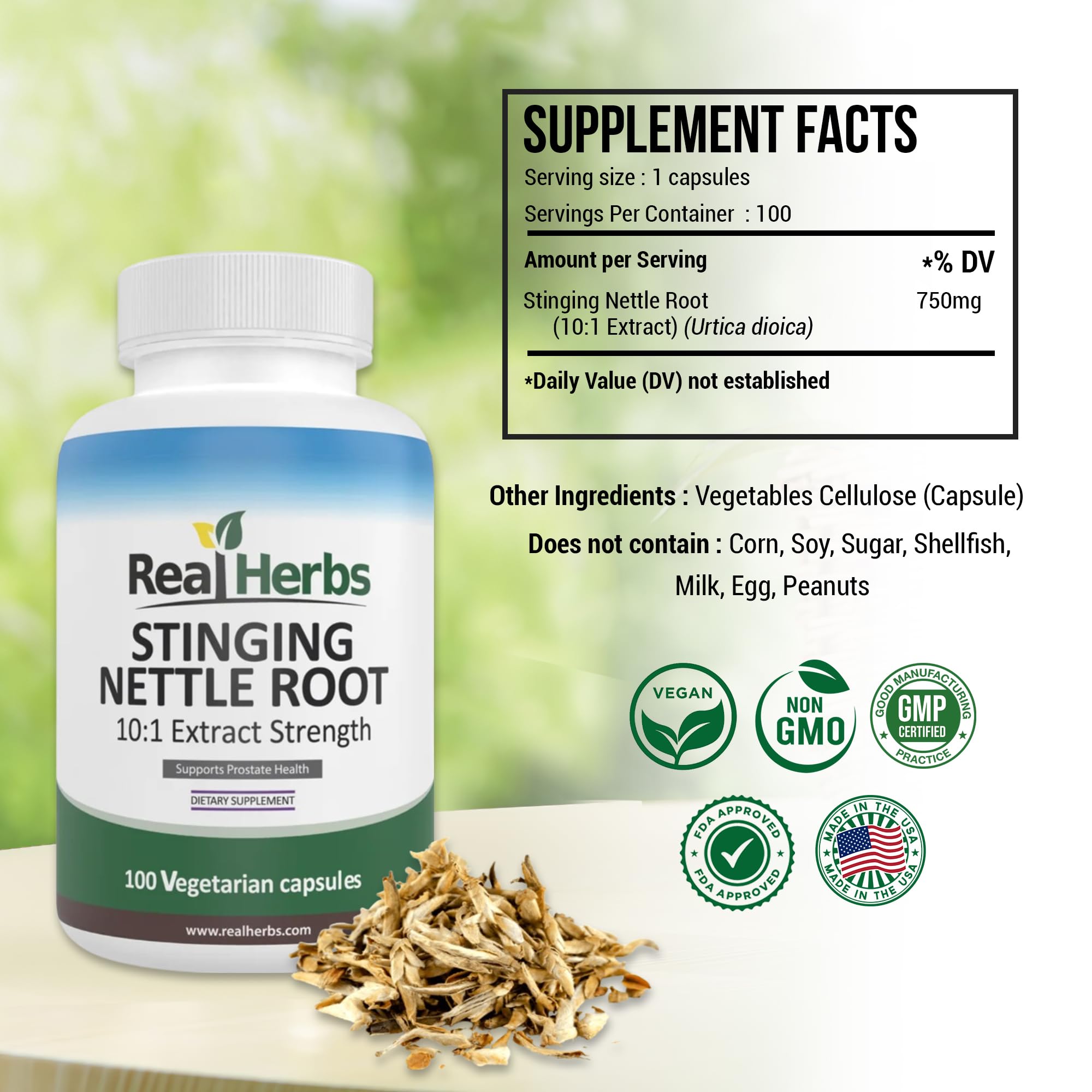
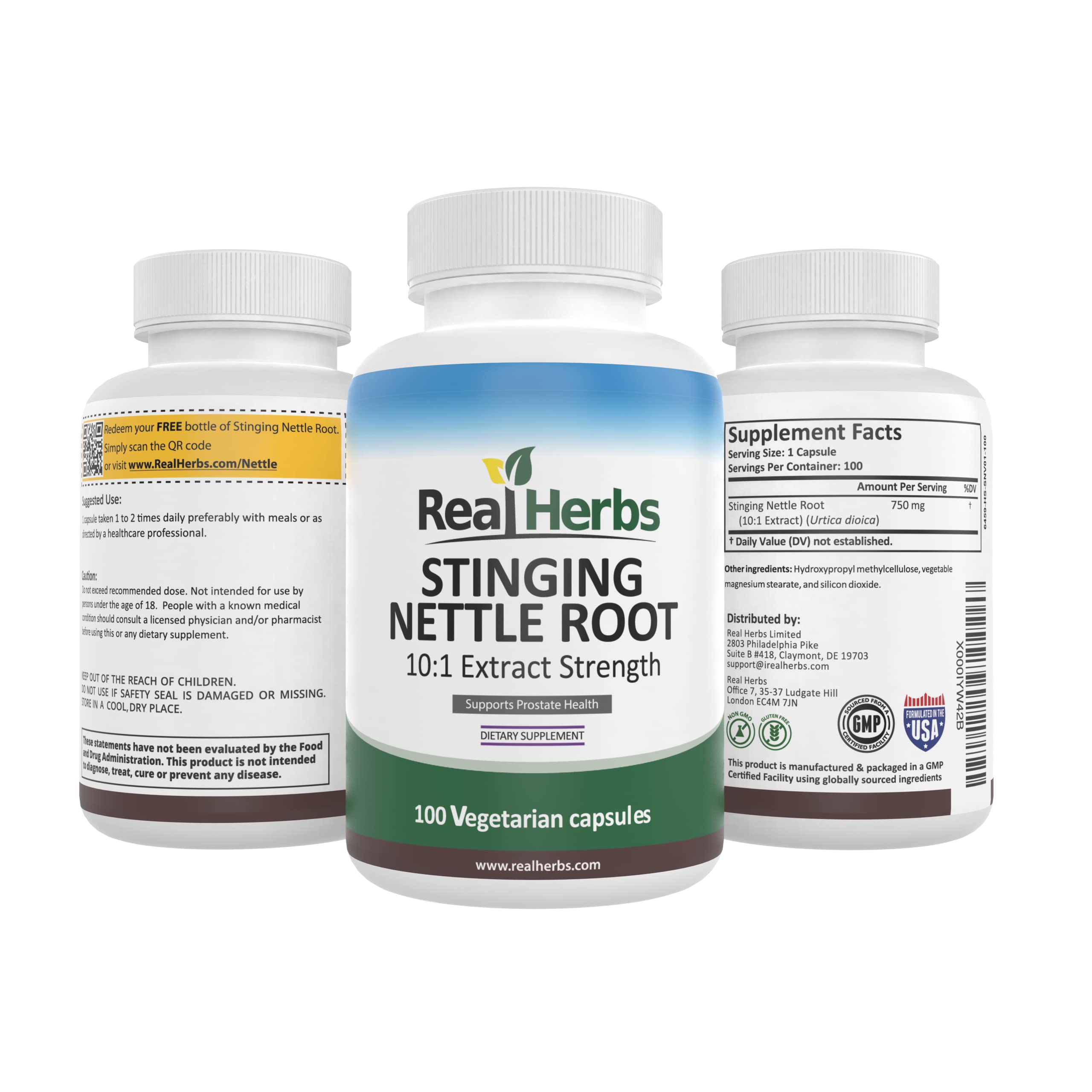
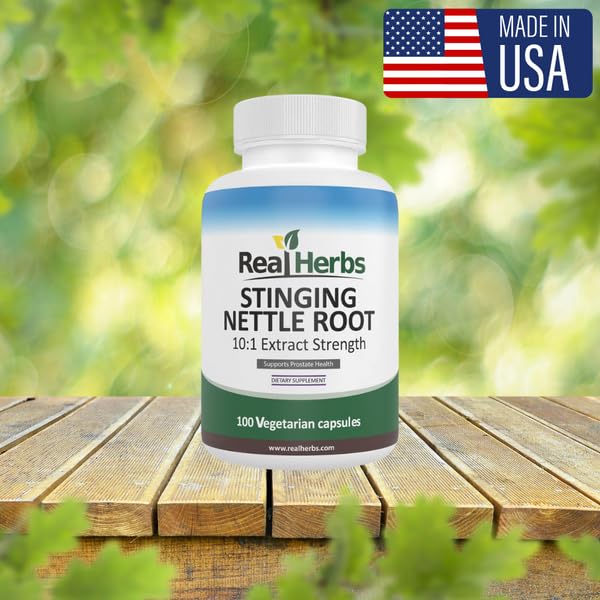
Two numbers appear on most nettle root labels: the amount per capsule in milligrams, and often an extract ratio such as 10:1. The ratio describes how the extract was made. A 10:1 extract uses about 10 parts of dried root to make 1 part of extract, so a 750 mg capsule of 10:1 extract is made from roughly 7,500 mg of dried root.
Reviewers note that only a few components of the active principle in nettle root have been identified ([1], PMID 17509841), so a ratio tells you how the extract was made, not how much of a known active compound it contains. Extracts made with different solvents (water, ethanol, methanol) can also differ in what they contain. For these reasons, milligram figures from different products and studies are not directly comparable.
Swipe sideways to see all columns.
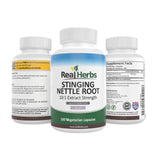
| Label item | Real Herbs Stinging Nettle Root Extract |
|---|---|
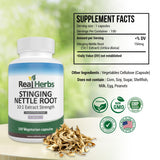
| Amount per capsule | 750 mg of extract |
| Extract ratio | 10:1 (about 10 parts dried root to 1 part extract) |
| Dried root equivalent per capsule | About 7,500 mg (750 mg × 10) |
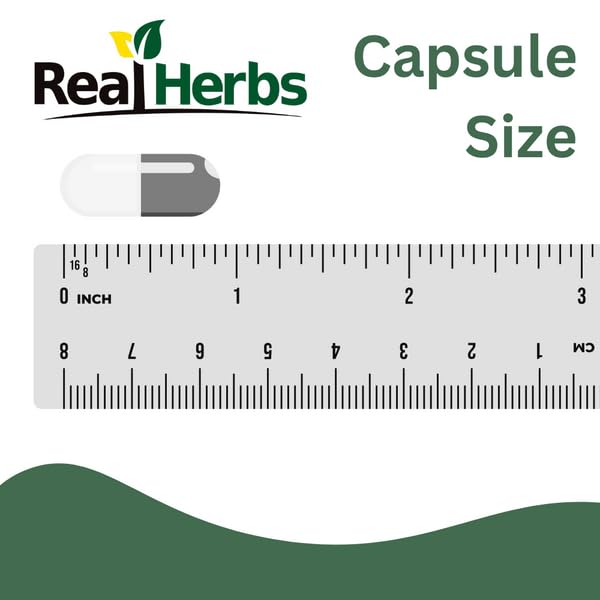
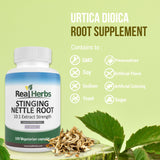
| Capsules per bottle | 100 vegetarian capsules (the label serving is 1 capsule) |
| Suggested use on the label | 1 to 2 capsules daily, preferably with meals, or as directed by your healthcare provider |
Root or leaf? Everything on this page concerns the root. Nettle leaf is a different material, studied for different goals, and its doses should not be read across to the root.
Doses used in human trials
The table lists every human trial in this guide, with the dose as reported in its PubMed abstract. IPSS results for these trials are covered in our guide to stinging nettle root for BPH.
Swipe sideways to see all columns.
| Trial | Men | Product tested | Dose reported | Length |
|---|---|---|---|---|
| Safarinejad 2005 | 620 | Urtica dioica extract | Not given in the abstract | 6 months controlled, followed to 18 months |
| Schneider 2004 | 246 | Nettle root extract (Bazoton uno) | 459 mg dry extract | 12 months |
| Karami 2020 | 60 | Nettle root extract, tablets | 450 mg a day | 12 weeks |
| Lopatkin 2005 | 257 | Combination capsule: 160 mg saw palmetto extract + 120 mg nettle root extract | 1 capsule twice a day | 24 weeks |
| Sökeland 1997 | 543 | Same combination (PRO 160/120), compared with finasteride | 2 capsules a day | 48 weeks |
| Melo 2002 | 49 | 25 mg pygeum + 300 mg nettle extract | Schedule not stated in the abstract | 6 months |
Human trial Of the three trials of nettle root alone, the two that state a dose in their abstracts report 450 mg a day of root extract as tablets over 12 weeks ([2], PMID 32981268) and a 459 mg dry extract over 12 months ([3], PMID 15045190). The largest trial, in 620 men, does not give its dose in the abstract ([4], PMID 16635963). The two combination trials used the same fixed product, which contains 120 mg of nettle root extract per capsule next to the saw palmetto ([5], PMID 15928959; [6], PMID 9340898). A combination trial with pygeum used 300 mg of nettle extract ([7], PMID 15748367).
The trials used different extracts, so these figures show what was studied and are not a recommended dose.
What the EMA monograph lists
The EMA’s herbal committee published a monograph on nettle root in 2012 for the relief of urinary symptoms related to BPH, after a doctor has excluded serious conditions. It lists doses by type of extract, for adults and the elderly ([8]). The document has since been marked superseded, so treat it as a reference point and not a prescription.
Swipe sideways to see all columns.
| Form listed by the EMA (2012) | Adult dose |
|---|---|
| Dry extract, 20% methanol (7.1 to 14.3:1) | 160 mg three times daily, or 460 mg once daily |
| Dry extract, 20% ethanol (6.7 to 8.3:1) | 240 mg three times daily |
| Dry extract, 70% ethanol (12 to 16:1) | 150 to 190 mg twice daily |
| Liquid extract (1:1, 30% ethanol) | Up to 5 mL a day, in 3 or 4 doses |
| Herbal tea (decoction) | 1.5 g of cut root, 3 to 4 times daily |
The monograph says long-term use is possible, that oral use is intended, and that nettle root has no relevant use under 18 ([8]). It does not give instructions on time of day or on taking the dose with or without food.
Capsules, tablets, liquid extracts and tea
The two nettle-alone trials that report a dose both used a dry extract, one as tablets ([2], PMID 32981268) and one as a 459 mg dry extract ([3], PMID 15045190), and the combination trials used capsules ([5], PMID 15928959). The EMA monograph lists a liquid extract and a tea alongside the dry extracts ([8]). We found no trial that tested a nettle root tea or tincture in men with BPH symptoms, so the form that suits you is a practical choice and not one the research has ranked.
Swipe sideways to see all columns.
| Form | What the research lists | Practical notes |
|---|---|---|
| Capsules or tablets (dry extract) | Used in the trials; the EMA lists three dry-extract regimens | Each serving contains a stated amount of extract, so the dose is easy to track. Check the extract ratio and the serving size on the label. |
| Liquid extract or tincture | EMA: 1:1 extract in 30% ethanol, up to 5 mL a day in 3 or 4 doses. No trial cited here | Contains ethanol. Use the dropper or measure on the product, and check the label for the extract ratio. |
| Tea (decoction of cut root) | EMA: 1.5 g of cut root, 3 to 4 times daily. No trial cited here | A decoction is simmered, not steeped. The strength depends on the root and how it is prepared. |
Whichever form you choose, keep the same product while you judge how it suits you, because switching between extracts also changes the amount and type of extract you take.
Timing and food
None of the trials cited here tested time of day or taking the dose with or without food, and the EMA monograph gives no instruction on either ([8]). The research does show two patterns for how doses were spread out: a single daily dose (460 mg once daily for the methanol dry extract) and divided doses (for example 160 mg three times daily, or 150 to 190 mg twice daily for the 70% ethanol extract) ([8]). In the combination trials, the dose was one capsule twice a day ([5], PMID 15928959).
That leaves timing largely a matter of what is practical for you. Our label suggests taking the capsule preferably with meals. The EMA monograph lists stomach complaints (nausea, heartburn, a feeling of fullness, gas, diarrhoea) among possible reactions ([8]), so a meal is a reasonable place to start, and if you notice stomach upset you can mention it to your pharmacist or doctor. Pick a time you will remember, and take it at about the same time each day.
How long to take it
The controlled trials above ran from 12 weeks to 12 months, and the largest followed some patients for 18 months ([2], PMID 32981268; [3], PMID 15045190; [4], PMID 16635963). The EMA monograph says long-term use is possible ([8]). Reviewers describe the risk of adverse events with nettle root as very low ([1], PMID 17509841).
Because the studies measured results over months, it makes sense to judge any change over a similar period and not over a few days. A review with your doctor after a few months is a sensible way to decide whether to continue, and your symptom scores and PSA checks are best tracked alongside the supplement, not instead of it.
Safety and who should check with a doctor first
The EMA monograph lists possible stomach complaints and allergic reactions (itching, rash, hives), reports no interactions, and says nettle root has no relevant use under 18 ([8]). In the 12-month trial, adverse events were fewer with the extract than with placebo ([3], PMID 15045190).
See a doctor first to find the cause of urinary symptoms, because BPH and prostate cancer can look alike. See a doctor again if symptoms worsen or you develop fever, spasms, blood in the urine, painful urination or trouble passing urine ([8]). Because the cited trials did not test nettle root with other drugs, ask your doctor or pharmacist first if you take medication for blood pressure, diabetes or blood thinning, or if you are pregnant or nursing. Keep up your regular prostate checks. See the full guide: who should avoid stinging nettle root.
Frequently asked questions
How much stinging nettle root should I take?
No single dose is established. Trials of nettle root extract report 450 mg a day and a 459 mg dry extract, and the EMA monograph lists regimens that depend on the extract type, for example 460 mg once daily of a methanolic dry extract. For a supplement, follow the label (ours suggests 1 to 2 capsules daily, preferably with meals) or the advice of your healthcare provider.
Does a 750 mg capsule mean 750 mg of nettle root?
No. In our product, 750 mg is the weight of the extract. With a 10:1 ratio it is made from about 7,500 mg of dried root. Neither number can be compared directly with trial doses, because the trials used different extracts.
Is a capsule, tincture or tea best?
No trial cited here compared the forms. The trials used dry extracts as tablets or capsules, and the EMA monograph also lists a liquid extract and a tea. Capsules give a stated amount of extract per serving, which makes the dose easy to track.
What is the best time of day to take nettle root?
None of the studies cited here tested time of day, and the EMA monograph gives no instruction on it. Our label suggests taking it preferably with meals. Choose a time you can keep up each day.
Should I take nettle root with food?
Our label suggests taking it preferably with meals. The EMA monograph lists stomach complaints among possible reactions, so if you notice any, mention it to your pharmacist or doctor.
How long should I take nettle root?
The controlled trials ran from 12 weeks to 12 months, and the EMA monograph says long-term use is possible. Judge any change over months, and review it with your doctor.
Can I split the dose across the day?
Both patterns appear in the research. The EMA monograph lists 460 mg once daily for one methanolic dry extract and divided doses for others, such as 160 mg three times daily or 150 to 190 mg twice daily. Follow the schedule on your product label.
Can I take nettle root with my medicines?
The EMA monograph reports no interactions, but the trials cited here did not test nettle root with other drugs. Ask your doctor or pharmacist first, especially if you take medication for blood pressure, diabetes or blood thinning.
Is nettle leaf dosed the same way?
No. This guide covers the root. Nettle leaf is a different material studied for different goals, and its doses should not be read across to the root.
The bottom line
There is no single established dose of nettle root, but the research gives a clear picture of what was studied: dry extracts of 450 mg a day and 459 mg in the trials that state a dose, a range of regimens in the EMA monograph, and results judged over months. Follow the label of the product you choose, take it at a time you can keep up, and review your progress with a doctor or pharmacist.
Real Herbs Stinging Nettle Root Extract: 750 mg of 10:1 root extract per capsule (about 7,500 mg dried root equivalent), 100 vegetarian capsules. Backed by our 100-Day Money-Back Guarantee. Real Herbs sells this product. The trials and the EMA monograph did not test this exact product.
Related reading
References
- Chrubasik JE, Roufogalis BD, Wagner H, Chrubasik S. A comprehensive review on the stinging nettle effect and efficacy profiles. Part II: urticae radix. Phytomedicine. 2007;14(7-8):568-79. PMID 17509841 · DOI 10.1016/j.phymed.2007.03.014
- Akbar Karami A, Sheikhsoleimani M, Reza Memarzadeh M, Haddadi E, Bakhshpour M, Mohammadi N, et al. Urtica Dioica Root Extract on Clinical and Biochemical Parameters in Patients with Benign Prostatic Hyperplasia, Randomized Controlled Trial. Pak J Biol Sci. 2020;23(10):1338-1344. PMID 32981268 · DOI 10.3923/pjbs.2020.1338.1344
- Schneider T, Rübben H. Stinging nettle root extract (Bazoton-uno) in long term treatment of benign prostatic syndrome (BPS). Results of a randomized, double-blind, placebo controlled multicenter study after 12 months (in German). Urologe A. 2004;43(3):302-6. PMID 15045190 · DOI 10.1007/s00120-004-0532-7
- Safarinejad MR. Urtica dioica for treatment of benign prostatic hyperplasia: a prospective, randomized, double-blind, placebo-controlled, crossover study. J Herb Pharmacother. 2005;5(4):1-11. PMID 16635963
- Lopatkin N, Sivkov A, Walther C, Schläfke S, Medvedev A, Avdeichuk J, et al. Long-term efficacy and safety of a combination of sabal and urtica extract for lower urinary tract symptoms--a placebo-controlled, double-blind, multicenter trial. World J Urol. 2005;23(2):139-46. PMID 15928959 · DOI 10.1007/s00345-005-0501-9
- Sökeland J, Albrecht J. Combination of Sabal and Urtica extract vs. finasteride in benign prostatic hyperplasia (Aiken stages I to II). Comparison of therapeutic effectiveness in a one year double-blind study (in German). Urologe A. 1997;36(4):327-33. PMID 9340898 · DOI 10.1007/s001200050106
- Melo EA, Bertero EB, Rios LA, Mattos D. Evaluating the efficiency of a combination of Pygeum africanum and stinging nettle (Urtica dioica) extracts in treating benign prostatic hyperplasia (BPH): double-blind, randomized, placebo controlled trial. Int Braz J Urol. 2002;28(5):418-25. PMID 15748367
- European Medicines Agency, Committee on Herbal Medicinal Products. Community herbal monograph on Urtica dioica L., Urtica urens L., their hybrids or their mixtures, radix (nettle root). EMA/HMPC/461160/2008. Adopted 24 September 2012; marked superseded by the EMA. ema.europa.eu
Disclaimer: This article is for educational purposes only and is not medical advice. Talk with a qualified healthcare professional before starting any supplement, especially if you have a medical condition or take medication. These statements have not been evaluated by the Food and Drug Administration. This product is not intended to diagnose, treat, cure, or prevent any disease.